Syndrone
A deep generative drone synthesizer for evolving ambient, cinematic and experimental sound. Syndrone combines autonomous voices, MIDI performance, 16 synthesis structures, long-form evolution, spatial motion and a four-slot modulation matrix in one instrument designed to keep changing long after a conventional patch would have settled.
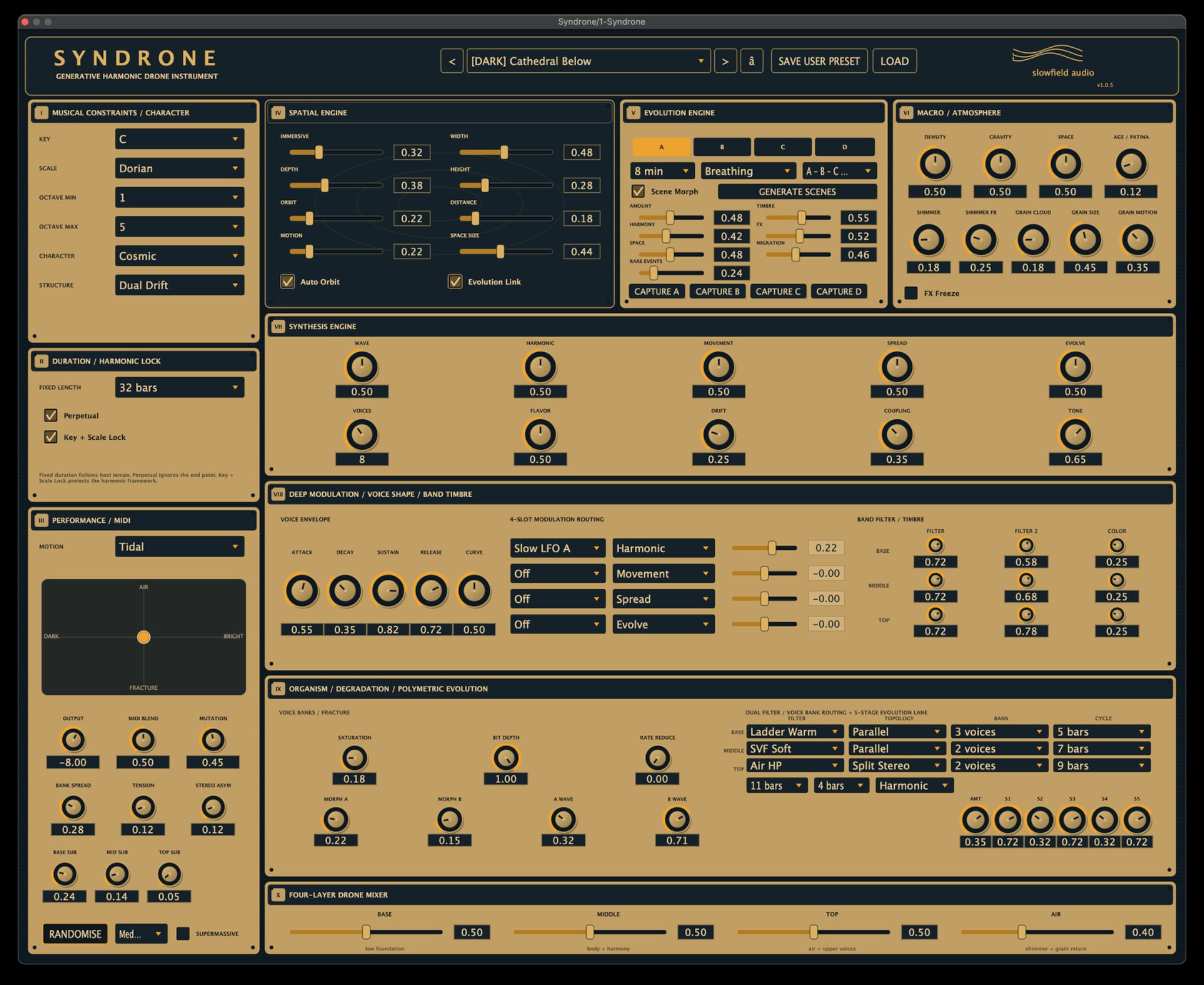
Build a drone, then let the instrument keep composing its interior.
Structure + Character
Structure chooses the fundamental synthesis behaviour. Character then reshapes harmonic weighting, movement, spread, tension and tonal personality, so the same engine can move from warm and organic to mechanical, fragile, radiant, monolithic or alien.
Designed for duration
Generate fixed 16, 32 or 64-bar forms, or switch to Perpetual for effectively endless evolution. Key, scale and octave constraints keep autonomous voices musically coherent.
A simple starting path
- Choose Key, Scale and octave range. Give the generator a harmonic world.
- Select Structure and Character. Establish the synthesis identity.
- Set Evolution Time. Try 8 or 16 minutes for unhurried movement.
- Shape Space and Mass. Establish width, depth, orbit and scale.
- Add one modulation route. Slow or random movement into Tone, Harmonic, Orbit or Age is often enough.
- Listen longer than a loop. Syndrone is designed to reveal itself over time.
Sixteen different ways to generate the core material.
Movement measured in minutes, not milliseconds.
Scenes A–D
Capture four musical states, then use Scene Path and Scene Morph to travel between them gradually.
Evolution shapes
Rise/Fall, Breathing, Wander, Tide, Bloom, Collapse and Generative determine how change develops over time.
Tip — evolve without becoming busy
- Start with two scenes. Make A dark and narrow, B brighter and wider.
- Use 8–16 minutes. Let the transition breathe.
- Keep Evolution Amount moderate. Avoid changing every dimension at once.
- Enable Evolution Link. Let the spatial field move with the composition.
- Use Rare Events sparingly. A little unpredictability feels intentional.
Four slots, but a much larger vocabulary.
Subtle
Brownian Walk → Tone, Slow LFO → Orbit or Smooth Random → Width can keep a patch alive without revealing an obvious cycle.
Rhythmic
Host Tempo Phase, Euclidean Pulse and Probability Pulse can add structure without turning the drone into a conventional sequence.
Macro
Targets such as Mass, Age, Grain Size, Shimmer Feedback, filters and layer levels let a single source reshape entire regions of the sound.
From first drone to deep generative system.
Beginner — Warm Bed
Dorian scale, Warm Character, Dual Drift, 4–8 voices, 8-minute Wander, moderate Width and low Shimmer.
Intermediate — Glass Cathedral
Lydian scale, Phase Glass, Radiant Character, Scene A/B morph, Shimmer + Grain Cloud and Brownian Walk → Orbit.
Advanced — Alien Monolith
Phrygian or Locrian, Cluster Unison, Alien Character, Mass + Supermassive, 16-minute Generative evolution, Probability Pulse → Top Filter and Brownian Walk → Age.
Hot tips
- Age / Patina is an excellent slow destination when you want the sound to appear to weather over time.
- Mass builds scale; Supermassive pushes density and body further without being a simple gain boost.
- Scene Morph + Evolution Link can turn one static preset into an entire evolving piece.
- Use the mixer last. Base, Middle, Top and Air can focus an enormous patch without redesigning it.
- Randomise gently first. Gentle and Medium are often better creative tools than Wild when you already like the patch.
Why this beta exists
Syndrone is intentionally deep. Long-running sessions expose CPU behaviour, state-recall issues, modulation edge cases and whether a patch stays musically interesting after ten or twenty minutes.
Feedback that helps
Please include your DAW, OS version, plugin format and the preset or Structure in use. Repeatable clicks, CPU spikes, state-recall problems, unusual gain changes and Randomise issues are especially useful.
Syndrone v1.0.5 beta installers are available above for macOS and Windows.